Question No 1
Diagonal Relationship in the Periodic Table
The similarity in properties observed between two elements placed diagonally from left to right in two adjacent periods and two adjacent groups in the periodic table is known as the diagonal relationship.
The diagonal relationship is prominent among the lighter members of the second and third periods elements. Thus, Li (Lithium) of group IA shows the diagonal – relationship with Mg (Magnesium) of group IIA, Be (Beryllium) of group IIA shows the diagonal – relationship with Al (Aluminium) of group IIIA, and B (Boron) of group IIIA shows the diagonal – relationship with Si (Silicon) of group IVA respectively.
Below is example of Diagonal Relationships in periodic table 
The diagonal relationship is well illustrated between Li and Mg in their following properties –
1. Melting – Unlike the alkali metals of Gr I but like Mg of Gr. II the melting and boiling points of Li are higher.
2. Decomposing – Li2Co3, LiNo3, and LiOH all decomposed on heating to give Li2O like the corresponding compounds of Mg.
3. Solid Bicarbon – Li does not form solid bicarbonate like Mg whereas Na – forms solid NaHCo3.
4. Solubility – Li2Co3, Li2Po4, LiF are all insoluble in water like the corresponding Mg salts. LiOH is also sparingly soluble in water like Mg(OH)2.
5. The halides and alkyls are co-valent like the Mg halides and alkyls. So these compounds are soluble in organic solvents.
Reason for the Diagonal Relationship
The reason for the diagonal relationship is their equal polarizing power or Ionic Potential. Polarizing Power or Ionic Potential = (Ionic charge)/(Ionic radius). For example, Li+ is a small size cation with a +1 charge and Mg2+ is a somewhat larger size cation with a +2 charge, so the ionic potential of each of the Li+ and Mg2+ ions is roughly the same.
Question No 2A
Electron affinity is defined as the change in energy (in kJ/mole) of a neutral atom (in the gaseous phase) when an electron is added to the atom to form a negative ion. In other words, the neutral atom's likelihood of gaining an electron.
Introduction
Energy of an atom is defined when the atom loses or gains energy through chemical reactions that cause the loss or gain of electrons. A chemical reaction that releases energy is called an exothermic reaction and a chemical reaction that absorbs energy is called an endothermic reaction. Energy from an exothermic reaction is negative, thus energy is given a negative sign; whereas, energy from an endothermic reaction is positive and energy is given a positive sign. An example that demonstrates both processes is when a person drops a book. When he or she lifts a book, he or she gives potential energy to the book (energy absorbed). However, once the he or she drops the book, the potential energy converts itself to kinetic energy and comes in the form of sound once it hits the ground (energy released).
When an electron is added to a neutral atom (i.e., first electron affinity) energy is released; thus, the first electron affinities are negative. However,
- First Electron Affinity (negative energy because energy released)
- Second Electron Affinity (positive energy because energy needed is more than gained):
First Electron Affinity
Ionization energies are always concerned with the formation of positive ions. Electron affinities are the negative ion equivalent, and their use is almost always confined to elements in groups 16 and 17 of the Periodic Table. The first electron affinity is the energy released when 1 mole of gaseous atoms each acquire an electron to form 1 mole of gaseous -1 ions. It is the energy released (per mole of X) when this change happens. First electron affinities have negative values. For example, the first electron affinity of chlorine is -349 kJ mol-1. By convention, the negative sign shows a release of energy.
When an electron is added to a metal element, energy is needed to gain that electron (endothermic reaction). Metals have a less likely chance to gain electrons because it is easier to lose their valance electrons and form cations. It is easier to lose their valence electrons because metals' nuclei do not have a strong pull on their valence electrons. Thus, metals are known to have lower electron affinities.
This trend of lower electron affinities for metals is described by the Group 1 metals:
- Lithium (Li): -60 KJ mol-1
- Sodium (Na): -53 KJ mol-1
- Potassium (K): -48 KJ mol-1
- Rubidium (Rb): -47 KJ mol-1
- Cesium (Cs): -46 KJ mol-1
Notice that electron affinity decreases down the group.
When nonmetals gain electrons, the energy change is usually negative because they give off energy to form an anion (exothermic process); thus, the electron affinity will be negative. Nonmetals have a greater electron affinity than metals because of their atomic structures: first, nonmetals have more valence electrons than metals do, thus it is easier for the nonmetals to gain electrons to fulfill a stable octet and secondly, the valence electron shell is closer to the nucleus, thus it is harder to remove an electron and it easier to attract electrons from other elements (especially metals). Thus, nonmetals have a higher electron affinity than metals, meaning they are more likely to gain electrons than atoms with a lower electron affinity.
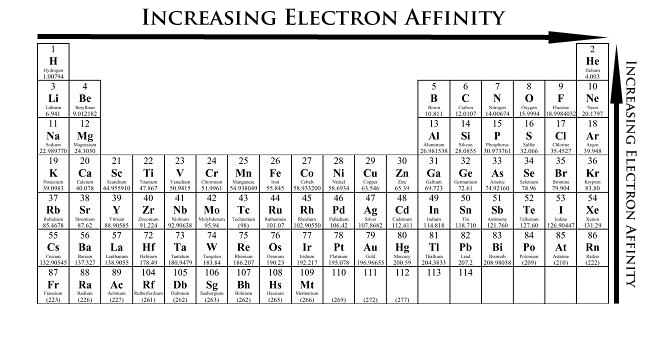
Periodic Table showing Electron Affinity Trend
Question No 2B
Question No 3
Explanation:
The 1st period consists of two elements, and the 2nd and the 3rd periods contain 8 elements each. They are called short periods. The rest periods are called long periods as they contain 18 or more elements. The 4th and 5th periods contain 18 elements each but the 6th and the 7th periods have 32 elements.